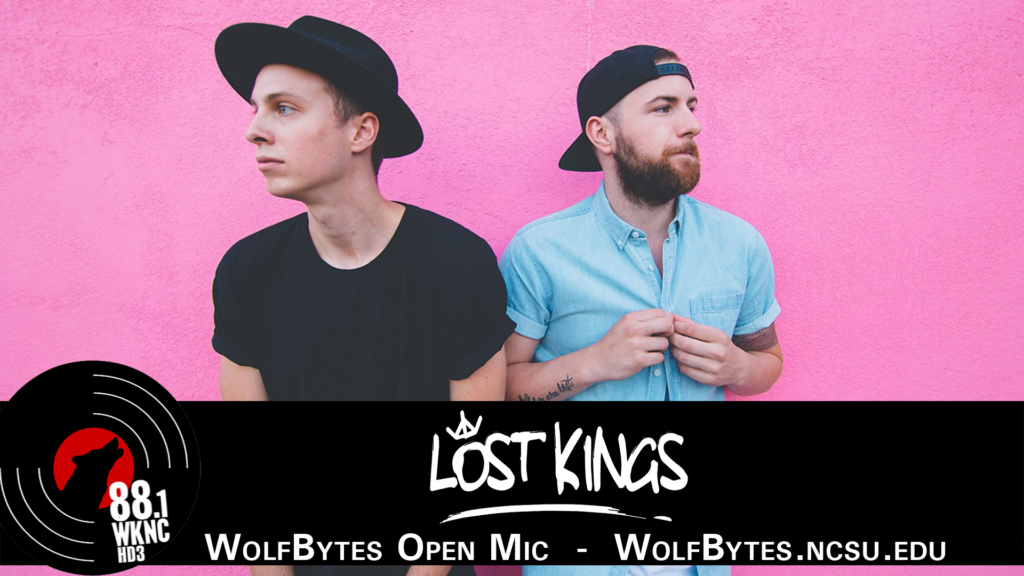
Open Mic with Lost Kings!
Speaker 1: (00:17)
Chris Lehman: (00:18)
Welcome back to another installment of Wolf bites. Open Mike, Chris Lehman, back with you. Got a great pair of guests with me, Nick and Rob from Lost Kings. Guys, how’s it going today?
Nick: (00:30)
Hey, what’s up man?
Rob: (00:32)
Good man. Good.
Chris Lehman: (00:34)
Good, good. And I think you guys are supposed to be in the area here real soon too, for a show.
Rob: (00:41)
Yeah. Tomorrow night, or I don’t know when this airs, but tomorrow, Thursday.
Chris Lehman: (00:46)
Yeah. Yeah. Yeah. Well, I wanted to start out kind of just with some general background about the two you, and Rob, I’ll start with you. Because I’m a pretty big sports guy, myself. And from what I’ve heard, you wanted to play professionally. At school, you were playing to be a professional athlete or wanted to be, and I was wondering what, what sports did you play growing up?
Rob: (01:09)
Well, I think I was like the goal for a lot of kids, probably at the age that I was when I had those dreams. I’ve played baseball like my whole life. And that was kind of the plan, to go to college, to play baseball and do that. And I pitched in my senior year, right before my senior year, during summer league, I blew my shoulder out. So that kind of changed my focus and plans and everything of, kind of like where I was going to go to school and all the things, because I hurt my arm so bad. But yeah, that was like the pipe dream of dreams, growing up. That was my first love for sure, was baseball and pitching and that whole world.
Speaker 1: (01:50)
Yeah. And now Nick, you were what I understand involved in music from a pretty young age. I think you started out on the drums. I was curious, does that have any kind of impact on the way you see music? It seems to me drums are a little bit different. Do you think that has any kind of impact on the way you look at music?
Nick: (02:12)
Yeah. I mean, I think I’m glad I started out on drums because it’s the backbone of every song. It’s what makes you feel every song rhythm is so important, and I think one of the driving forces of being a producer is having good rhythm. I’ve definitely come in contact with people that can play guitar, play piano, but if you don’t have rhythm. That’s such a big thing in music. Like you got to have like, it’s, I mean, so much modern music now is, the drums are just so key. I mean like sometimes that’s how you even, I even start a song it’s just with the drums first. And that may be because I’ve been playing drums since I was a young kid, but yeah, to me I’m very happy. I feel like there’s a collective of amazing producers that were drummers first. I mean, you look at like Travis Barker. Yeah. There’s a lot of guys like Murder Beats. Like those guys, like they all, there’s a lot of drummer producers that are killing it just because I feel like it’s such a backbone of music, and no matter what genre you’re in, it’s like the driving force. So I’m glad I started out on drums and then kind of made my way to guitar, piano, and everything so I could expand my writing.
Chris Lehman: (03:32)
And I think both of you guys grew up on the East Coast and now of course you’re based out of LA and ninth. That’s where you found each other. How did you end up meeting and start collaborating on music?
Rob: (03:45)
Yeah. We were both doing music out here in different, doing different things. But we had a mutual friend who kind of realized we were kind of trying to accomplish the same goals and had some similar aspirations. And we got together, he introduced Nick and I, and we started talking one night just about what we wanted to do. And we were like, “All right, let’s get together, and maybe we can teach each other some things.” I wanted to really learn producing, because that’s what Nick was doing. And I was deejaying at the time. I was going to help Nick learn the ins and outs of deejaying. And then when we got together, we like realized we kind of clicked and had the same goals and similar tastes. And we’re like maybe we attack this together. And we started working that night and I like legitimately haven’t stopped since.
Chris Lehman: (04:37)
So Nick, I’ll ask you, what do you think it is about the two styles that you had, obviously Rob talked about, you guys just kind of clicked. What do you think allowed you guys to click and why do you think you guys work so well together?
Nick: (04:49)
I think because we have different strengths and weaknesses. Like for me, I was never a relationship network type of dude. I’m not a social butterfly kind of guy. I was always buried in the music and being creative. When I met Rob, I think it’s good that we do different things. Rob was so good, I remember when we first linked up, he was so good at hitting everybody up and letting them know what we were doing, and then becoming friends with everybody. And that’s so important for your career because then you depend on certain people for certain things, and building those relationships are super key for us building any sort of success. And so like our managers, our agents, it’s like Rob can step in a room and be friends with anybody.
Nick: (05:42)
I’m not that person. I am very, like, social anxiety, blah, blah, blah, that kind of vibe. I had the music, it was just like, but then again, it would be weird if like Rob was like all up in my business with the production. I feel like we’d butt heads and we’d be like we both have similar tastes in music and both come at it from a different perspective. So that I think really is what allowed us to become friends, start the music career and then, all at the same time and we haven’t had a problem. We’d been together for seven, eight years. So it’s really key. I think if we were the same type of person, it wouldn’t have worked out. We probably wouldn’t be together right now.
Chris Lehman: (06:23)
All right. And speaking of your musical, let’s start talking a little bit about some of the songs and the remixes specifically, because that’s where you started. I mean, I remember I Bet My Life remixed by Imagine Dragons was a great one. Overdrive, that one gets your heart going. The Gecko remix is a great one. So you guys really started out and I feel like a lot of electronic artists start out kind of getting noticed with remixes of some of the more mainstream artists. You guys though, still continue to do some remixes. I think it was last year, you guys remixed Small Talk by Katy Perry. What is it about the remixes that you enjoy and why do you continue to do them?
Nick: (07:08)
To me, it’s an avenue to experiment a little bit. Because we have our originals and I have like, what I want [inaudible 00:07:15] to do with that. You know what we envisioned with that. But with remixes, this is a chance for me to like try some new stuff that I haven’t tried yet or put a spin on a song that I think is a good song, but could be even better if it was in like… I always want to beat like what the original is in some sort of way. And that’s always the goal. So I think if I really love a song, I want to hear it spun differently. And it’s also a chance for people to discover us that may not know our originals, but they’re like, oh, I love this song. And I love this version of this song. It was so key, it was such a building block, remixes for our career in the beginning. So it’s still something that we like to do from time to time.
Chris Lehman: (08:03)
And so I’ll start with Rob with this one. What is your favorite song that you guys have have remixed? I know you guys have a lot of them.
Rob: (08:10)
Oh God. That’s tough. One that always holds like the, a huge place in my heart because it really got us our start in the industry and broke down some barriers for us was the remix of Latch that we did for Disclosure.
Rob: (08:29)
(singing).
Rob: (08:38)
It was a bootleg remix, but Nick and I, it was before we had management and agencies and we sent the the MP3 to the program director at BPM at the time. We tracked down his email. And he got his ear and he said, how much he loved it. And then two weeks later he was like I replaced the original version of latch with yours. So anytime it was going to play, like we’re playing your version. And it still plays on BPM to this day. And that was without any management agency. And that kind of just was like, all right, like, these guys are for real, they did this on their own. We still play it out. It still goes off. So that one to me is just like, with everything that it means like for the career and what it’s done for us. And then also just how epic it still is. That’s probably my favorite.
Chris Lehman: (09:30)
What about you Nick? Maybe outside of latch. What’s one of your favorites that you’ve remixed.
Nick: (09:34)
Favorite remix? Probably the Rihanna, the Work remix.
Nick: (09:38)
(singing)
Nick: (09:38)
That’s probably my favorite just because to have just the vocals in my computer of Rihanna and Drake, it was insane. And I just remember being so aghast the whole time I was making that, and it really did well for us. And that was like one of the last remixes we did. I think that was the last remix we did before we really went ham with the originals and everything. So it was, I don’t know, we just kind of wanted to go out with a bang at that time, and that one just… those are two iconic artists to me and that was like, yeah, that’s definitely my favorite. I still listen to that from time to time.
Chris Lehman: (10:31)
And you talked about getting into your originals. What was it like when you released your first original? I’m sure there are some extra nerves that go along with that. Because it’s a little bit different than remixing at that point.
Nick: (10:45)
Yeah. It was definitely a little, definitely nerves a little bit just because you’re stepping out, really testing your following and your fans that have loved your remixes. And you just wonder if they’re going to love your original story and original music, but it’s so important for us. As producer artists, we’re not singing on the song. So like it’s so key that our production stands out in a way that people want to resonate with it. And also tell our story through other people’s singing and you want people to resonate with that story. And for us, even that first song, the first original we put out that, Bad.
Nick: (11:23)
(singing)
Nick: (11:30)
I just remember being… it just felt right. That was going to be the one, we were going to switch it up a little bit from what we did with the remixes. And that was going to be… We were just ready. Ready, ready, ready. And it’s obviously evolved since then, but I think what we’re doing now is what the end goal always was, but we’ve had to experiment and do a lot of test the waters, do a lot of different things. But yeah, it’s always nerve-wracking. Because you want people to really resonate with your original story and original music. That’s most important to us. Because making remixes is cool, and I can experiment, and everything, but at the end of the day, that’s that person’s story, that’s that’s person’s song. We’re just adding to their story. I want to add to my own story and what Rob and I are doing, I want people to resonate with that.
Chris Lehman: (12:17)
And it feels like 2017 I think was a really, really strong year for you guys. You had a lot of good releases. Quit You, Look At Us Now, First Love, Don’t Call, We’re All In There. And then you can even go back to late 2016 with Phone Down. That kind of seemed like when everything really started to take off, at least in terms of your originals. So what was that year like if there are any stories that go along with that year for you guys that you remember, or a favorite song that you had that year?
Rob: (12:47)
Yeah. It’s funny. Because you don’t really look at it while you’re in it. You don’t really look at [inaudible 00:12:54] year. Now it’s kind of can be like, oh, okay, this and this happened. That was just really like, we had just signed a record deal with RCA who we’re still with now and kind of got into the groove of releasing on a regular basis. Before that we were with Spinning Records, which is like a dance-heavy record label. And it was we were just doing some certain things on there. It just really got us into like the start of what we’re doing now. Some of those records are really paved the way to how we release music now and really allowed us to build a core following.
Rob: (13:29)
And it got us on pop radio, for the first time. So that was just really the kickoff of like what we do as I feel like original artists too now. And what our original music and everything was like, that was kind of the foundation and, and just really making us a staple in the scene, where more than just like your core dance followers got to know us. We were playing pop radio festivals and doing different things. So that was just kind of a really good time to finally get out in front of more than just like the core dance crowd. And now we’ve just built on that.
Chris Lehman: (14:10)
And one other thing that I kind of wanted to talk about a little bit, and you talked about kind of building a following and releasing music, and that kind of brings me to Spotify and social media. And the first one I want to kind of talk about is Spotify, because it feels like you guys do a good amount of Spotify. You got a good following there. How has that, it really seems like that’s kind of changed the environment when it comes to releasing music and how music is consumed. How is it on your end? Because I know as a consumer of music, it’s great. But how has that experience been for you guys and how has it helped you?
Nick: (14:46)
It’s great because you can release week-to-week if you really want. You have a lot of freedom and creative freedom, and there’s a lot of playlists out there that allow people to discover music. It’s a great platform, but it is more challenging than it ever has been because it’s so competitive and there’s songs being released every week. It’s a little, on our end of it, like, yeah, I love getting new songs every Friday, but from a releasing standpoint, you release a song on Friday, after that week is up and the next Friday everybody’s on to the next song. And so it’s like kind of makes you mentally feel like that if people aren’t adding your song to their playlist, that it’s kind of it’s hard mentally to kind of get over the hump that it’s like, people actually still maybe not have heard that song, or because people, not everybody keeps up with it every week, because it’s a lot of music. It’s a lot of people releasing a lot of music.
Nick: (15:50)
To stand out is very hard and it’s super competitive and that is a challenge as we release music. You’ve got to just keep it coming. And that has changed, you can’t do no one album a year, or you got to do songs every month. It’s a challenge for sure.
Rob: (16:10)
Yeah. And like just even building off the… Spotify was really driving what people were listening to for a while and like getting into playlisting and everything. And now it’s this ever-changing game of Spotify because there’s all these playlist that’s used to drive plays on your Spotify page, but now more so than anything, it’s like TikTok. And TikTok is driving what people are consuming on Spotify, and Spotify is going off the trends from TikTok. So it’s this ever-changing and evolving music business on how to succeed that like, we’re just in it and navigating as we go, because it changes really on a weekly basis.
Chris Lehman: (16:56)
And one other thing, when it comes to Spotify, I was just looking through your Crown Jewels playlist that you had, and I noticed Mountains was in there. And I was curious about, I’ve always kind of wondered how much, obviously you enjoy the music you produce. How much do you listen to your own music, and do you glean anything from listening back to songs that you’ve produced in the past?
Nick: (17:17)
Yeah. For me, I feel like I listened to while I’m making a song, I’ve heard it a million, million times. And so it’s hard for me to go back and listen after it’s out. I kind of just let it be when it’s out. But I obviously do go back and listen. I have to wait a while though, because then I get real perspective when I go back and listen, I’m like, oh. It’s weird. You kind of get lost in the process. And then I hear it so much that I’m like, all right, I want to hear what other people’s opinions on this. I can’t listen to this on a regular basis. But I think what my favorite place to here is being able to play the show is like, that’s when I get to really… That I feel like it’s always the same feeling, every time we play a show. You hearing it in that environment with the energy. It’s kind of hard after hearing it there to listen in your car.
Rob: (18:07)
I’m similar. But what I have noticed that I’ve been doing a lot more recently is watching the music videos. I don’t have a playlist of the songs on say Spotify, but it I’ve been watching the music videos, especially over quarantine because a lot of the videos are almost like these travel vlogs, and one in particular sticks out as Stuck and the video we have for that and where we’re traveling.
Rob: (18:31)
(singing)
Rob: (18:42)
Playing like Ultra Europe. And it’s just this amazing trip. So I definitely have been watching that to feel some nostalgia and everything because it’s… More so than ever miss traveling. I have found myself watching, reliving the music videos for sure.
Chris Lehman: (19:00)
When it comes to concerts, you obviously get back out and you get to do some touring. Now, how does it feel, to start with you Nick, because you talked about playing a song at shows and in front of crowds, how does it feel to after a year plus of not being able to do that, to be able to do that again?
Nick: (19:17)
That’s unreal, man. You kind of take it for granted before everything happened with the world. So coming back and being able to do it, like doing Lala a couple of weeks ago. Just that kind of level of show is just unbelievable. And I think all I kept saying the whole weekend was just “Dude, I just want to stay in the moment as much as possible.” Because I think now it’s like really, I find myself really just trying to do a better job at not taking it for granted. It just drives everything. Because for so long [inaudible 00:19:52] obviously everybody was dealing with it, you’re getting no… we’re making music, but you’re getting no fulfillment from it. So it’s like hard to stay motivated. But now back to playing shows and getting to see people’s responses even after a year and a half, that people are coming out to the shows and still caring feels good, feels great.
Chris Lehman: (20:10)
So is there anything on the horizon, obviously you’ve got some tour dates, you’ll be in the area here in North Carolina here soon. Anything else going on for you guys that you’re really excited about?
Rob: (20:22)
Yeah. Like tomorrow at Alchemy, that kicks off the I Missed The Future tour. So that’s a huge thing because we been waiting to do a full, a real tour for two years now since the last one. So the fact that it kicks off tomorrow is so big and it goes till pretty much November, almost weekend. So it’s like, that’s what we’ve been gearing up for, and have some… hitting all the cities that we’ve missed and get to see some familiar faces. But yeah, so the tour is what we’re been looking forward to.
Chris Lehman: (21:03)
All right guys. Well, I really appreciate you jumping on here and talking real quick, it’s been a lot of fun, and I hope you guys have a good time at Alchemy.
Nick: (21:12)
Appreciate you having us man, thank you.
Rob: (21:14)
Oh, thank you bro.
Chris Lehman: (21:15)
Absolutely. That was Nick and Rob from Lost Kings. Be sure to like and subscribe.