
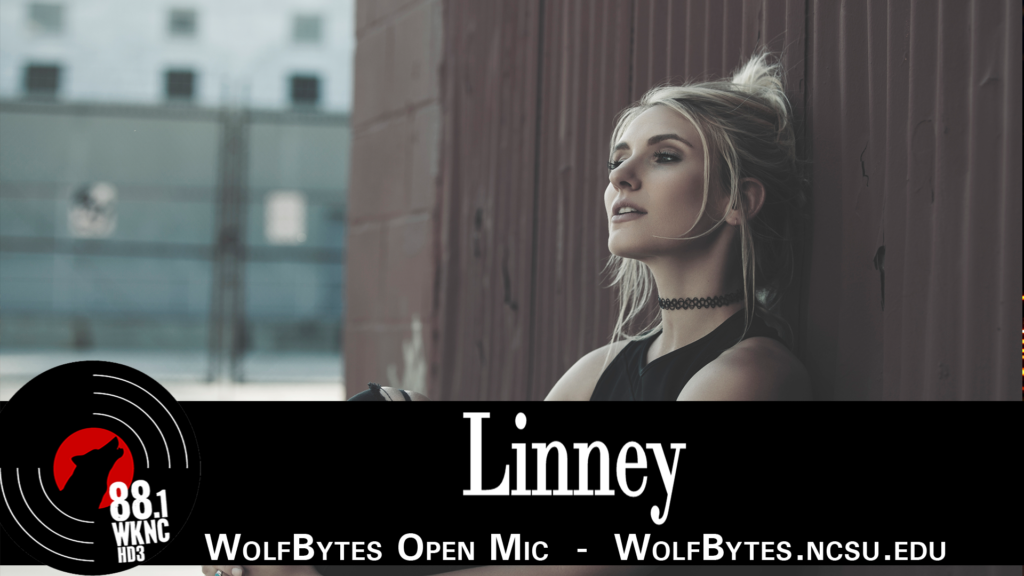
Open Mic with Linney!
Nathan Wyatt-Ingram: (00:18)
What’s up? Nathan here at Wolf Bytes Radio and we are back with another episode of Wolf Bytes Open Mic. Today we are joined by a very special guest, Caitlin Linney.
Linney: (00:27)
Hi, it’s so good to be here. Thanks for having me.
Nathan Wyatt-Ingram: (00:30)
Thank you for being on with us today. You’re a North Carolina local. Am I right?
Linney: (00:34)
Yes, I grew up in the Durham Chapel Hill area.
Nathan Wyatt-Ingram: (00:37)
Fantastic. That’s where we’re based, Raleigh, North Carolina. So very excited to have a local person on board with us today.
Linney: (00:44)
Yeah.
Nathan Wyatt-Ingram: (00:44)
Where are you stationed now?
Linney: (00:46)
I live in Los Angeles now. I was actually just home in North Carolina for a month. I got back here on Sunday. It so good to be back. But yeah, I live in Los Angeles and I have my home studio here and just been surviving this past year.
Nathan Wyatt-Ingram: (01:03)
Yeah. So how has the pandemic been for you? We ask pretty much everyone this question when they come on since it is such a pressing topic. How has it been for you?
Linney: (01:12)
I was talking to my manager yesterday about how the timing of this all lined up. I transitioned from pop into EDM in 2019 really when I had the song with Gareth Emery and we got to perform it for 6,000 people in Minneapolis. And then like a couple months later COVID hit. So on one hand it was kind of disappointing because I didn’t get to go perform the songs live at the festivals last year but I was in my studio for a year just recording music. So I feel really grateful that I had the capacity to do that from my apartment and I feel really lucky that we were able to grow my yearly Spotify account from like 780,000 to seven million.
Nathan Wyatt-Ingram: (02:05)
Yeah, that’s popping. Definitely getting up there. That’s great to hear. [crosstalk 00:02:14]. You spent a lot of time working on your sound then.
Linney: (02:14)
Yeah. I feel like I was one of those weird kids that at four or five I was like this is what I want to do. I want to sing, I want to write me music and everybody in North Carolina was incredibly supportive of that including my scientist parents who worked at Duke. But I think I went through phases of pop, country. I studied some jazz at school in Boston. And the thing that I feel really proud of is we’ve really identified a sound for my voice and I feel like that can transcend two genres. And with EDM it’s becoming more mainstream, more pop recently. I like to think that my voice is my brand and I can bring myself to multiple genres.
Nathan Wyatt-Ingram: (03:01)
Absolutely. And there’s another question I was going to ask you later on, but we can bring it up now. Indie pop, you have that in your Instagram bio. What is that? Can you define it for me?
Linney: (03:13)
That’s a funny question. When I think of pop, especially now after having been in the industry for a while, I very much think about the major labels. The people, a lot of times they have stars from the Disney channel who just blow up and they’re amazing and they’re talented but they have this huge budget behind them. And when I think of indie pop, I think of more of like the bedroom producers and the people who are just like, I’m going to figure this out and grow my artist project on my own and self-release and figure it out that way.
Nathan Wyatt-Ingram: (03:49)
Do you think that’s going to be a more a mainstream way for people to get into music coming the future?
Linney: (03:55)
Doing self-release and stuff like that?
Nathan Wyatt-Ingram: (03:57)
Yes.
Linney: (03:58)
I think honestly it took me a very long time to get around to TikTok, but it seems like I’m finally on there, whatever, but it seems like people are just putting themselves out there. They’re being raw and real and they’re getting picked up by labels. I was on this call maybe six months ago where I heard like the A&Rs at Capitol being like, yeah, this is how we find our talent now which in a way is really cool because it gives everybody a chance. If you think back like, I don’t know, maybe like 40 years ago, the only way to get on the radio was to go through a major and be one of the few people that was selected to do that and now everyone’s kind of taking that into their own hands.
Nathan Wyatt-Ingram: (04:37)
Yeah. And I think before even TikTok, SoundCloud is a way for a lot of people to push themselves through.
Linney: (04:43)
Definitely. Yeah, definitely.
Nathan Wyatt-Ingram: (04:44)
Was that something you used?
Linney: (04:47)
SoundCloud, I haven’t ever like really dived in there. I use it mostly for sharing private links to collaborators but I haven’t fully utilized SoundCloud.
Nathan Wyatt-Ingram: (05:03)
It’s fine. I watched a couple of your TikTok yesterday, I think, just to see how much you used social media in regard to your brand and yourself. And I was wondering, since you are the younger, I would say, younger person, is it easier for you to use social media or has it been beneficial even?
Linney: (05:21)
Well, my main platform is Instagram for sure. It’s so interesting because I actually wrote a song about this. I think it’s incredible that we have the opportunity to connect with people across the world. That’s insane. The Internet’s amazing for that reason but it’s also just so much information being fed to you at once and it can be extremely overwhelming. I can’t imagine growing up today with all of the screens in my face as a little kid. I went and played outside in the woods and wrote songs about that. So I think you have to be careful with how much social media you’re consuming but I also believe it’s an invaluable tool. So some of my favorite people to work with recently when I’ve been in the studio with them I’ve talked about social media before and they’ve been like, “I actually put a cap on my Instagram. There’s a warning that pops up and says 25 minutes, you’re done for the day.”
Linney: (06:22)
So I think as an artist you have to be really careful about what you’re exposing yourself to because I’m like a sponge. I soak up everything and not all of it is great. So you have to definitely prioritize your mental health.
Nathan Wyatt-Ingram: (06:35)
Absolutely. I’m glad that you brought that up as well. Mental health is an important issue that is more prominent today than it used to be. But speaking about social media, on YouTube, you posted a video in January asking for people to send in videos of themselves for the music video More Than Love.
Nathan Wyatt-Ingram: (06:59)
(singing)
Nathan Wyatt-Ingram: (07:01)
And a month later the video came out. I absolutely love that video by the way. It’s fantastic. I love the idea behind it. Who came up with that?
Linney: (07:10)
So that song’s with Somna and Andy Moore and I believe it just worked out that it was around Valentine’s day. Everybody was like, how can we bring the world together through screens and through the internet? I think it was Somna’s management that had the idea and it was just brilliant and it was a really fun way to just incorporate everybody who listens to the songs and lets them be seen and know that we care and they’re the reason that we’re able to do what we do. So I’m really glad that turned out the way that it did.
Nathan Wyatt-Ingram: (07:47)
And I bet that was pretty special for some big fans to be able to be in the video as well.
Linney: (07:52)
Yeah. There’s a couple in Canada. They’re nurses. They really liked my song Electric Kids with Tritonal. And their screen name on Instagram is Electric Kids. They put lights on their bikes and they drive around the city at night and blast music and just light up the city. And they were on the news for it. They got to send in some of their clips to the video and that was really special.
Nathan Wyatt-Ingram: (08:31)
Yeah, that definitely is a special moment for fans. I’m sure for you as well as you were able to connect with them.
Linney: (08:37)
Yeah. When you’re scrolling through and you just see comments. It’s like, oh, this one person’s image. You identify them with their screen names, but when you get to see actual footage or video, you’re like, “Oh, this is so cool. I feel like I actually know this person now.”
Nathan Wyatt-Ingram: (08:51)
And especially during the pandemic as well. We are so disconnected from people physically. The internet again saves us a little bit with that ability to connect ourselves, more especially with you and your fans and just other people in general as well. In a more recent track, Porcelain with Ummet Ozcan. Am I saying that right?
Linney: (09:29)
Yes. Yeah.
Nathan Wyatt-Ingram: (09:29)
Perfect. How did that come about? Tell me about that.
Linney: (09:29)
Okay. I became accustomed to doing Zoom sessions actually. One of my favorite writers to work with is a girl named Britt and her artist project is called [Pollyanna 00:09:40] and she and Jeff Chaney and I wrote the song to piano actually over Zoom. We were really inspired by this idea of Kintsugi. I’m probably saying that wrong, but it’s this Japanese art form of taking broken pottery and painting it with gold to repair it. So it’s this concept of accepting your imperfections and actually improving something, making it new after having it been broken. And so that’s what the whole song was about and I just loved it and it had this like kind of haunting section with the pre chorus. We had a feelinG that it was such an important message about accepting her imperfections and realizing that they make us who we are and make us unique.
Linney: (10:32)
She had worked with Ummet before and she sent him the song. And from what I heard was that he immediately loved it and started working on it. It was really fun to collaborate in that way. And so far the response has been really cool and I’ve heard from a couple people that it’s helped them through some difficult times recently.
Nathan Wyatt-Ingram: (10:53)
And that again is even more special for you I’m sure to hear that, that your music is making an impact as well and especially with that music video we just spoke about. The connection between you and your fans must be ridiculously positive as well.
Linney: (11:07)
Thanks for saying that.
Nathan Wyatt-Ingram: (11:10)
You’re welcome. Did you work on that fully remote then?
Linney: (11:13)
Yeah, a lot of times. It’s interesting because back, my first instrument besides my voice was piano. I was always doing like singer songwriter stuff and I was always this shy kid. I don’t know why I felt like I could sing a song and I wrote about the boy I liked in sixth grade to the whole school. Somehow music’s a super power in that way, but a lot of times in … Sometimes I write two tracks that I get sent, but my favorite thing to do is to write to piano because it allows me to fully shape out the song how I want it to and then we match it with a producer and then we go back and forth and build out the track.
Linney: (11:55)
So that’s been a really fun way to just maintain the integrity of what my heart wants to put into a song and allows when people hear it. If they’re like, I love this, they connect with it immediately. Sometimes it’s hard to write to a track because I think that the producer has something already in mind if they’re not in the room with you for sure. And you can either hit or miss with that. But I don’t know. I think the piano vocal always translates to EDM. And I’m actually exploring that idea with releasing some of my original stuff moving forward, doing an acoustic version and a full mix as well.
Nathan Wyatt-Ingram: (12:34)
Yeah, definitely. Is it more helpful to have that stripped down piano version moving forward?
Linney: (12:41)
Well, it’s also a test for me. If a song can exist just piano vocal then it’s a good song and it’s going to be even cooler when you can add a beat and like dance to it and go crazy. I think that it allows people to connect it with it in a different way because I think when you’re listening to the full mix, it’s got this energy and this drive and it can be really encouraging. And when you hear the piano vocal, it’s more like, oh, this is speaking to my soul.
Nathan Wyatt-Ingram: (13:10)
Mm-hmm (affirmative). So you mentioned dance to the track there. When you performed at the beginning of 2019, did you dance around on stage?
Linney: (13:19)
Oh, definitely, yeah. I was like, this is why Beyonce runs and sings at the same time. This is hard, especially if you’re wearing heels. But yeah, we had a lot of fun.
Nathan Wyatt-Ingram: (13:31)
That’s really great to hear. Unfortunately, you weren’t able to work with him in person. That would’ve been, I think, even better for the experience for you and just the music itself. I think from what you’ve said and what other people have said as well, it’s very difficult to collaborate through Zoom calls, but that is the reality we live in. So post pandemic, do you want to work with different people? Who do you have in mind?
Linney: (13:57)
I have a handful of songs that are coming out the rest of the year. I’m not sure if I’m allowed to actually.
Nathan Wyatt-Ingram: (14:04)
I’ll just keep it quiet. I won’t tell anyone.
Linney: (14:10)
Let’s see. I don’t even know. I don’t know if you guys have interviewed him. I’ve been a huge fan of Porter Robinson lately. Isn’t he in Chapel Hill?
Nathan Wyatt-Ingram: (14:23)
I do not know that personally, but…
Linney: (14:25)
I would love to work with Gryffin, ATB. And some of those things might happen. We’ll see.
Nathan Wyatt-Ingram: (14:40)
Fingers cross. Hopefully that will happen for you. You’re 10 years in the business now, right?
Linney: (14:46)
Yeah, I guess so. Yeah.
Nathan Wyatt-Ingram: (14:48)
Because I was looking just doing a little bit of research and it said you’ve been active since 2011.
Linney: (14:54)
Yep, that’s that seems correct. Yeah, 10 years. There you go.
Nathan Wyatt-Ingram: (14:58)
Wow. I’m sure you have lots to reflect upon from the past 10 years. Is there any major milestones you’ve had along the way?
Linney: (15:07)
Most recently, I was very, very excited when Electric Kids got picked up on Sirius and it made it onto the billboard dance charts, which is very cool. One of my indie pop songs, Coming Back For More, it won the John Lennon Songwriting Contest which is really fun. We got to perform at NAMM which is this big conference in Anaheim. I think one of my, not so much a milestone, but more of a lesson is I felt like it took me a really long time to figure out how to listen to myself and pay attention to my inner voice of what my music should sound like because when I moved to Los Angeles I wanted advice. I sought out advice a lot and every person I spoke with had a different idea about what I should do, how I looked, how I would fit. “Oh, you look like you’re from North Carolina. You should sing country music.” “Oh, you should do your hair like this.” Oh, you’re you’re too much of a nice girl. You need an edge.” And there were all these people trying to shape me and it got to the point where I was like, I don’t even know what I’m trying to do anymore.
Linney: (16:31)
I think it took removing myself from that a little bit and just writing, writing, writing and spending a lot of time playing with sounds to figure out what exactly felt authentic to me. And I finally feel like I’ve started creating some music that blends all the things that I love and I’m really, really excited to start releasing that in the next year or so.
Nathan Wyatt-Ingram: (17:00)
That’s fantastic to hear. Does that past year sort of quarantined in lockdown helped you really self reflect?
Linney: (17:09)
Definitely. And actually just being home. I grew up on like 10 acres of farmland and there’s lots of windows and high ceilings in the house that I grew up in and I spent a lot of time in this apartment in Los Angeles wishing that I could go home. I wrote a lot of music about wanting to go back to the woods essentially and reconnect with that. And being back there, it was an affirmation of like, wow, nature really inspires me. So I’m trying to figure out a way to blend this sort of organic sound of the piano with the electronic elements that my career has moved into. And for a while, people were like, “That’s too pop. That’s too dance.” And I feel like people are at a point where they’re accepting this idea of something strange and something new and like, okay, what is this? Let’s explore it.
Nathan Wyatt-Ingram: (18:11)
Absolutely. And sometimes you just have to shut out all the haters and just follow your dreams, right?
Linney: (18:17)
Yeah, definitely.
Nathan Wyatt-Ingram: (18:18)
So, how did you get into music?
Linney: (18:25)
Rewind. Let’s see. My parents are both scientists. They ran the Linney Lab actually in Duke, but there was always music in my house. I’ve been told that my dad is actually a really good singer but I’ve never really heard him sing. My mom’s a very good singer. I wanted to sing in the talent show. I think, what is it, Titanic can came out and everybody was singing that Celine Dion song and I wanted to practice singing and my mom made… I remember I was like singing really nasally or something and she told me to put my fingers over my nose and if I could sing without sounding nasal then I would learn the placement of where I would put my voice when performing and I just didn’t stop.
Linney: (19:13)
I spent my recesses practicing plays and performances. And eventually that took me to studying at Emerson College. I got into a BFA program with like 26 people in the musical theater department. I did that because I loved singing, acting and dancing but I felt like I was learning to be a caricature of a person rather than actually just like dive in deep and what am I feeling? What do I have to offer the world? So I left that program so I could take classes at Berkeley and do my last semester in Los Angeles where I interned at Warner Music in the licensing department. So I learned about how musicians can make money from getting their songs placed in TV and film. And then I got hooked on LA and was like, “I have to move out here after I graduated.” I just kept going, kept knocking on doors and not giving up.
Nathan Wyatt-Ingram: (20:16)
That’s a very important attribute to have that, that not giving up, that perseverance. Very important. So I definitely respect you for that. With all of those influences, you say your mother and father would’ve been a good support system for you?
Linney: (20:31)
Definitely. And thinking back I’m like, wow, I don’t know. I mean, I would like to think that I will be that supportive for my kids someday, but being a scientist, a part of a university that has everything set up with retirement plan and everything, being okay with having your kid be like, “I want to be a singer.” That’s kind of scary. But it’s been a cool year because I don’t think either of my parents really listen to dance music but they recognize the hard work that I’ve been putting in. My sister actually, she’s just got her PhD in science and so my dad’s been writing me emails every morning since I left for college and the most recent ones were like, I’m so proud of you guys. One daughter’s getting a PhD. You’re succeeding in the music industry. Two completely different fields, but I feel like I can rest easy now knowing that you guys are good. So that’s been nice.
Nathan Wyatt-Ingram: (21:30)
Must be a very proud moment for both of your parents as well.
Linney: (21:33)
Yeah.
Nathan Wyatt-Ingram: (21:37)
So moving on. More about influences. I’ve seen on your Instagram even in music videos you’ve had it’s a lot of color. How much of an influence does color have on your music?
Linney: (21:49)
That’s a really good question because I haven’t thought about that before, but that’s very true. One of my friends was explaining to me that she sees colors around people. It’s called something specific. I can’t remember the name of, but I’ve been thinking a lot about that, especially with writing Electric Kids. We wrote that after going to Dream State and I’ve always been raised in this idea that everybody has something unique to offer the world. We wrote the song thinking about this idea that everybody has a different color to their aura and something that they send off into the world that connects with everybody else and lights up the sky in a sense. I think that because I’m such a visual person, being able to tell all the story with that mood and those lighting, it lets you feel connected to that person in a way that feels universal because everybody knows those colors and you can feel like you’re in the same room if you recognize that because everyone has a different relationship with those colors but they see basically the same thing.
Nathan Wyatt-Ingram: (23:13)
That’s very true, yeah. Are you sure you haven’t practiced that explanation?
Linney: (23:17)
No. Did I make sense.
Nathan Wyatt-Ingram: (23:19)
It sounds like you knew what you were talking about there. That’s very great. Well thank you very much for being on here, Caitlin. I really appreciate everything from you. To all of you out there, don’t forget to subscribe and like us wherever you’re getting our podcast from and make sure to head of at wolfbytes.ncsu.edu for more information. I am Nathan here at Wolf Bytes Radio and we will catch you next time.